
Without Operator+
Teams assemble guidance manually from disconnected vendor releases, advisories, and compatibility notes.
Go/no-go decisions stall when version risk, blast radius, and policy exceptions are unclear.
Use case
Maintenance windows should start with a clear version posture, not fragmented portal checks. Operator+ correlates inventory, advisories, compatibility, and policy context so teams can make safer go/no-go decisions before rollout begins.
Keep ESXi patches, release notes, and compatibility guidance visible in one place so infrastructure teams can prepare maintenance windows with confidence.
Risk posture
Infrastructure teams lose time correlating ESXi versions, patch advisories, and compatibility matrices across multiple vendor sources.
Transformation
Teams assemble guidance manually from disconnected vendor releases, advisories, and compatibility notes.
Go/no-go decisions stall when version risk, blast radius, and policy exceptions are unclear.
Operator+ correlates version details, inventory posture, and compatibility signals in one governed view.
Teams get ranked, policy-checked recommendations and can approve rollout paths with clear accountability.
Governed decision record
Findings: Two ESXi 8.x security advisories and one compatibility flag were detected across target clusters.
Risk rating: Elevated - proceed only with dependency remediation and staged sequencing.
Recommended version path: Apply 8.x patch train in two waves, prioritizing clusters with no matrix conflicts.
Policy check result: Meets maintenance-window constraints for non-prod first; production requires CAB approval.
Approval status: Recommendation submitted, waiting on infrastructure lead and change-manager sign-off.
Audit reference: Decision record VP-2026-05-21-0910 links findings, approvals, and rollout outcome.
These decisions require manual cross-referencing across vendor portals, internal standards, and release notes.
Teams lose time validating source-of-truth and often enter change windows with unresolved dependencies.
Version risk, compatibility signals, and policy constraints are correlated in one governed decision record.
Ranked rollout paths and approval-ready context shorten go/no-go cycles before maintenance windows begin.
Every recommendation, decision, and outcome is logged for audit and post-window review.
Governance workflow
Inventory, advisories, and compatibility inputs are correlated into one version posture baseline.
Recommended rollout paths are checked by environment tier, change window, and approval scope.
Operators approve go/no-go decisions before any controlled upgrade or rollout execution occurs.
Findings, policy outcomes, approvals, and rollout results are recorded in a review-ready trail.
Interactive briefing
Two advisories affect clusters outside approved patch train; urgency is raised automatically.
Recommended sequencing shifts low-risk cluster updates earlier to reduce exposure quickly.
Inventory and release posture are assembled across validated sources.
Architecture flow
Operational outcomes
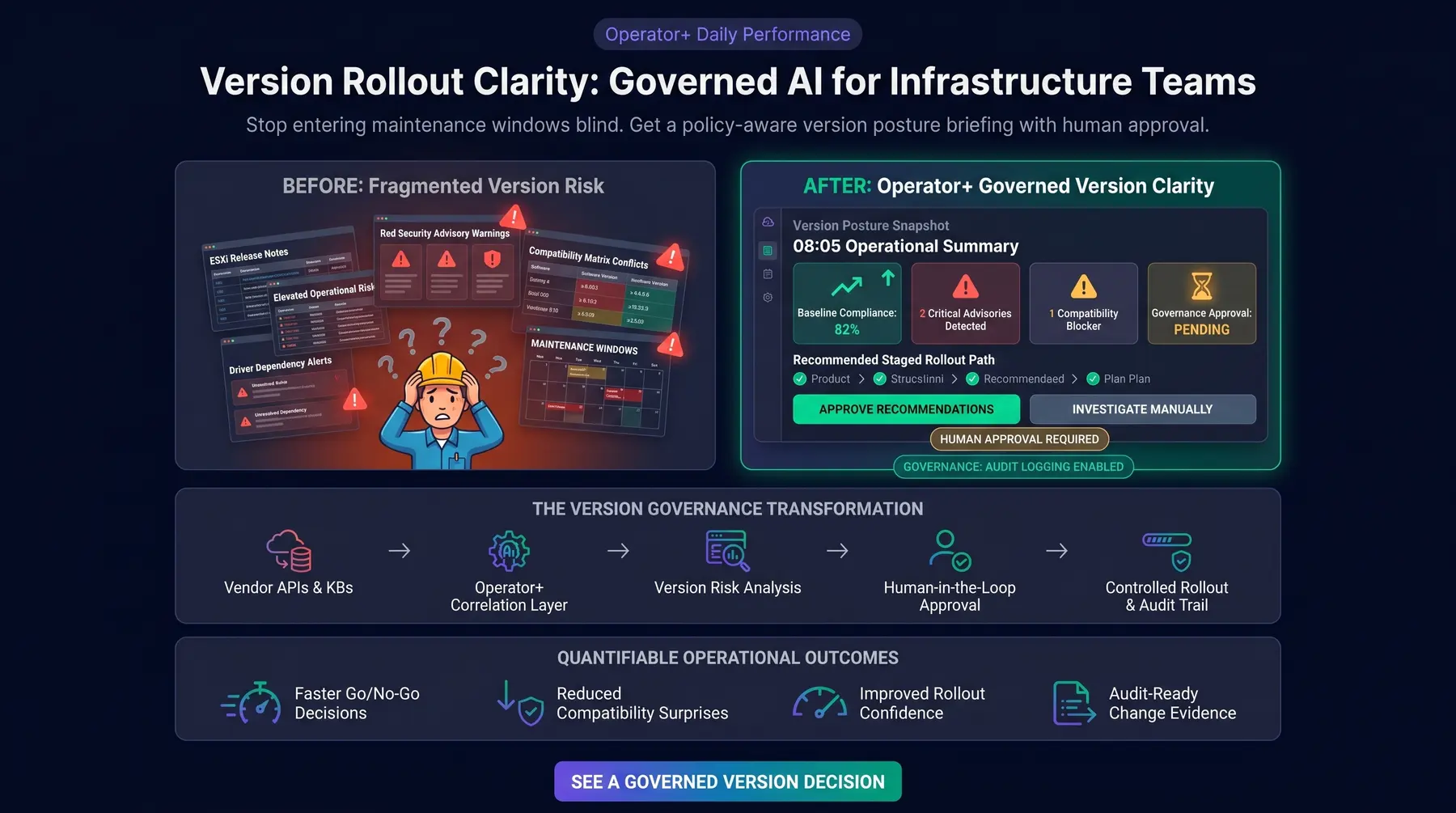
Teams move from fragmented research to ranked rollout decisions with less pre-window overhead.
Dependency and matrix risk is surfaced earlier, before rollout sequencing is locked.
Approval decisions, policy checks, and outcomes stay traceable for compliance and post-window review.
See how Operator+ helps your team reduce rollout risk while keeping every approval human-controlled and auditable.